Platform review · reviewed 2026-08-05
MNSTR
MNSTR publishes the most granular odds in this category and it is not close. Alongside tier probabilities, value bands, an average pull value and a buyback rate, it shows the individual pull probability of every one of the 364 cards in the pool — down to figures like 0.0032% on a $5,800.00 card. Nobody else comes near that.
It also produces the same result as everyone else once you follow the arithmetic through, which is rather the point of doing so.
The verdict
Why B: Per-card odds across the entire pool, tier bands, average pull value and buyback rate are all published before purchase — the best disclosure we have seen anywhere. Not an A only because we have not yet audited published odds against observed outcomes, and MNSTR's robots.txt blocks our automated access, so any audit has to be done by hand.
- Advertised value per $1
- 1.06
- Their own label: +6% on the $100.00 Great pack
- After the published buyback
- 0.943
- 89% buyback — the surplus goes back
- Odds granularity
- 364 cards
- Individual pull odds published per card. Category-best.
- Referral programme
- Effectively $0
- Points rank you on a leaderboard; only the top 10 are paid
The best odds disclosure in the category, attached to the same house edge as everywhere else. Worth using if transparency matters to you and you accept the packs are EV-negative — but not worth promoting, because the referral programme pays in leaderboard position rather than money.
Who is behind it
MNSTR is built by Andy (@andy8052), a well-known crypto-native builder who has been sharing the founding story publicly as it happens. His previous project, IKB, was a daily fantasy sports platform — genuinely well-executed, and one of the rare crypto products that reached an audience outside crypto, in the DFS community. It eventually wound down, in circumstances that from the outside looked a great deal like the regulatory difficulty that follows fantasy sports across jurisdictions.
That history matters for two reasons. It is a track record of shipping good products, which counts for something in a category full of anonymous operators. And it is a reminder that products in gambling-adjacent regulatory grey areas do sometimes stop — a risk worth holding in mind before leaving significant value vaulted anywhere.
The odds, and what they add up to
Packs run Starter at $50.00, Great at $100.00, Monster at $250.00, Ultra at $1,250.00, across Pokémon and One Piece. Here is the Great pack as published:
| Tier | Chance | Value band |
|---|---|---|
| Common | 72.53% | $56.00–$100.00 |
| Uncommon | 18.00% | $100.00–$200.00 |
| Rare | 8.73% | $200.00–$400.00 |
| Epic | 0.66% | $400.00–$1,000.00 |
| Legendary | 0.07% | $1,000.00+ |
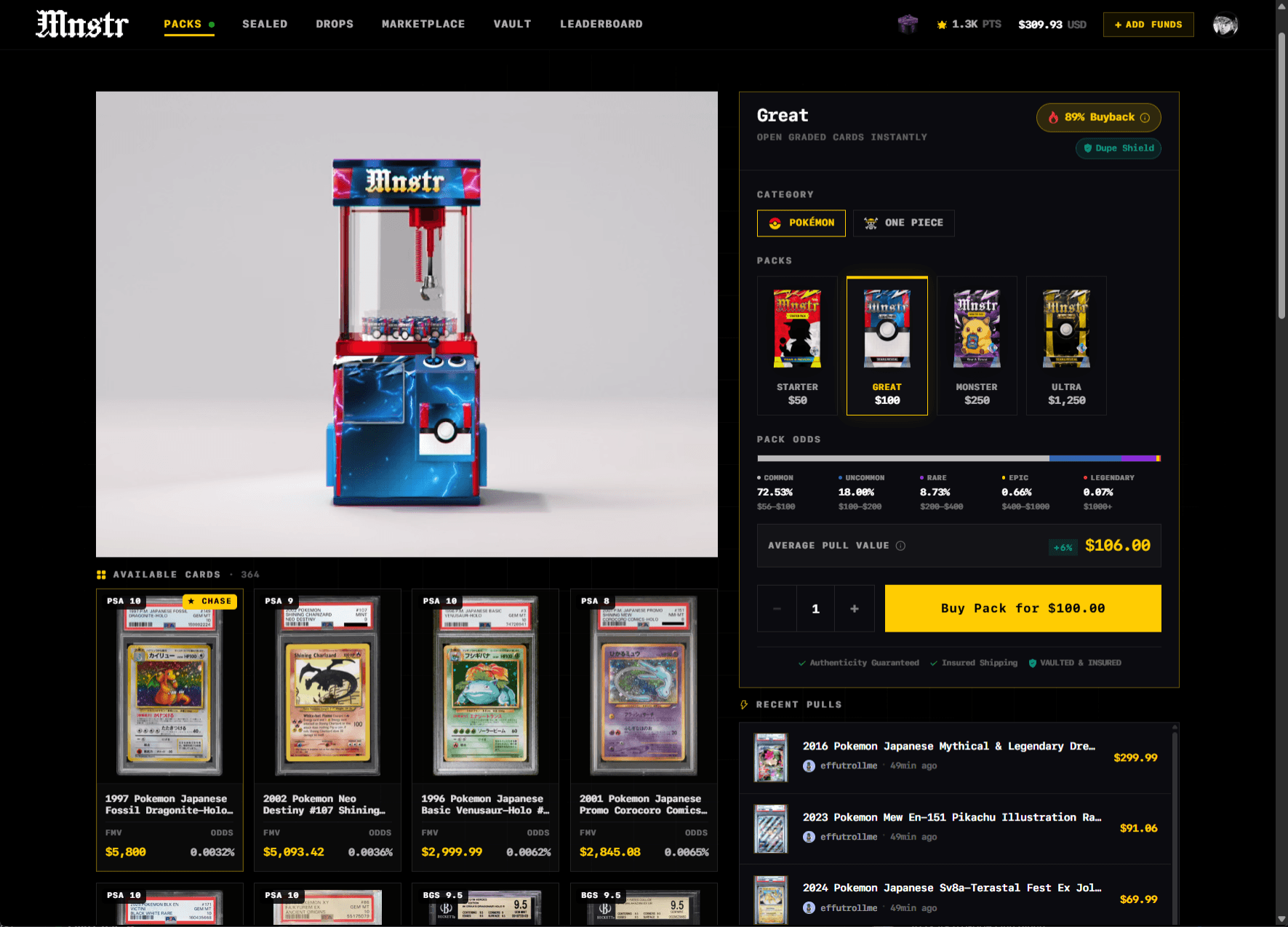
MNSTR labels the average pull value $106.00 and marks it +6%. Apply their own published 89% buyback and that becomes 0.943 per dollar — the same pattern we found on Collector Crypt, at almost exactly the same landing point. The advertised surplus and the buyback haircut cancel, and the house keeps around 5.7%.
Note also the common band: 72.53% of pulls land between $56.00 and $100.00 on a $100.00 pack. The single most likely outcome is a card worth less than you paid.
Dupe Shield genuinely helps — while it lasts
Pull a card you have pulled before and, if the rip still leaves you at a loss, you get a free pack back automatically. That is a real improvement to expected value rather than a marketing flourish, and we have not seen an equivalent anywhere else.
Two honest caveats. It pays only where duplicate and losing rip coincide, so its value depends on how much of the pool you have already seen — heavy users benefit far more than newcomers. And it is explicitly a promotion that runs while it runs. We have not modelled it into the figures above, which means our numbers understate MNSTR slightly while the promo is live.
The leaderboard is not income
MNSTR points do not redeem for anything. They rank you on a weekly leaderboard where the top three share free Monster packs — a $2,250.00 prize pool in the week we checked, split $1,000.00 / $750.00 / $500.00, with ranks four to ten receiving starter packs.
The distribution is the thing to understand. In that week 47 users were ranked; third place held roughly 129,000 points and the leader nearly 740,000. Points accrue at one per dollar across pulls, vault sales and marketplace buys. So the podium is occupied by people moving very large sums, and everyone else receives nothing at all.
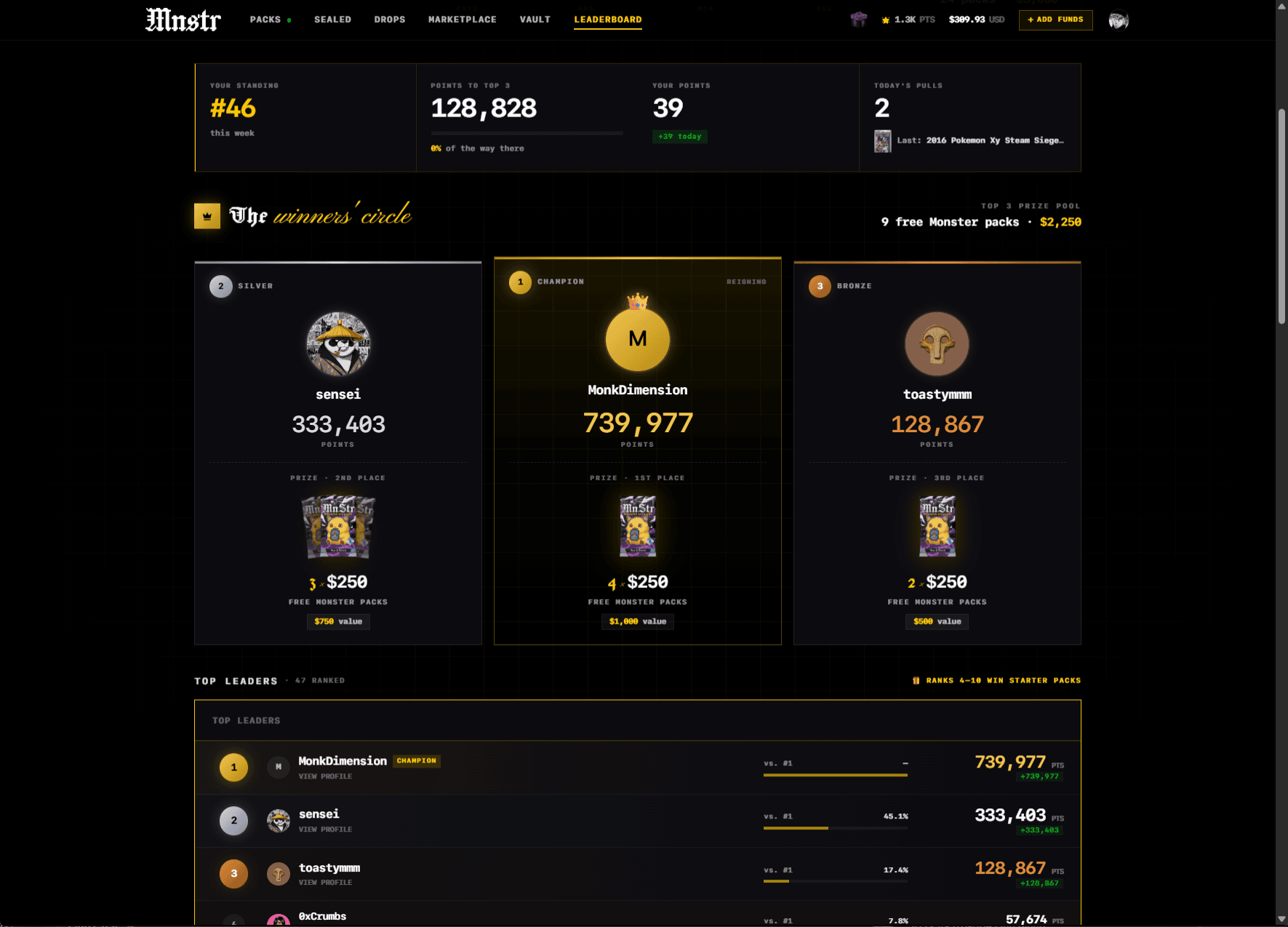
This is why we do not run a MNSTR referral page. The programme pays 5% of your referrals’ points — a share of a ranking, not of revenue. Unless your referrals are among the platform’s largest spenders, that share currently converts to nothing, and we are not going to imply otherwise to earn a click.
One caveat we think is fair to state. Everything above describes what points are worth today. MNSTR is early, and crypto-native platforms have a long history of rewarding accumulated activity retroactively — airdrops, allocations, free packs for users who were there first. Andy has built in this space before and will be thoroughly aware of that playbook.
So the honest framing is not “points are worthless” but “points have no determinable value now, and a possibility of value later that nobody can price.”We will not put a number on that possibility, because there isn’t one — but treating it as zero would be its own kind of false precision. If you are accumulating points here, do it understanding you are taking an unpriced bet on a future decision, not earning a stated rate.
Shipping and access
MNSTR charges a destination base plus $5.00 per card, applied to every card including the first: $25.00 for one card to the US, $45.00 to Australia, rising to $130.00 for eighteen. Import tax is not quoted — you accept responsibility for it at checkout. Their founder states shipping is priced flat regardless of which vault holds the card, and that the platform loses money on it. Full comparison in what redemption actually costs.
One note on our own limits: MNSTR’s robots.txt blocks automated access by our tools, which we respect. Everything on this page was read by hand from a live account, and any future odds audit has to be done the same way.
If you decide to sign up
Our code is MOONORACLE. It credits us 5% of the points you earn, which — as explained above — is worth essentially nothing unless you become one of the platform’s biggest spenders. We would rather tell you that than dress a leaderboard share up as a commission.
Referral link · we receive a credit if you use it · terms verified 2026-08-04
Frequently asked
- Is MNSTR legit?
- It behaves as described and publishes more granular odds than any competitor we have examined — per-card pull probabilities across a 364-card pool, plus tier bands, an average pull value and a buyback rate, all on the purchase screen. It is run by Andy (@andy8052), a known crypto builder whose previous project was the fantasy sports platform IKB. We have not yet completed a physical redemption from MNSTR ourselves.
- Is MNSTR called Monster or MNSTR?
- Both, confusingly. The brand and domain are MNSTR (styled 'Mnstr'), but its $250 pack tier is called Monster and leaderboard prizes are described as 'free Monster packs'. We use MNSTR for the platform and Monster for that pack.
- What is Dupe Shield?
- A promotion: pull a card you have pulled before, and if that rip still leaves you at a loss, you get a free pack back automatically. It genuinely improves expected value, but only where duplicate and losing rip coincide, and it runs only while the promo lasts.
- Can I earn from the MNSTR referral programme?
- Not in cash terms today. It pays 5% of your referrals' points, but points redeem for nothing directly — they only rank you on a weekly leaderboard where the top three share free packs, and third place required roughly 129,000 points in the week we checked. The honest caveat: MNSTR is early, and crypto platforms often reward accumulated activity retroactively. Points have no determinable value now and an unpriceable possibility of value later.
Reviewed 2026-08-05 · read by hand from a live account · redemption not yet tested end to end